Where DSCR Loans Actually Work in Mesa and Gilbert Right Now — A 2026 Deal-Level Analysis
Where DSCR Loans Actually Work in Mesa and Gilbert Right Now — A 2026 Deal-Level Analysis
Last Fact-Checked & Updated: May 6, 2026 by Travis Erickson (NMLS 1193479)
Most DSCR content about Arizona tells you the same thing: strong population growth, landlord-friendly laws, diversified employment, great market for investors. All of that is true. None of it tells you whether a specific property in a specific ZIP code actually qualifies at today's rates.
This post does. We're going to run the real numbers — at current May 2026 DSCR loan rates, with current Mesa and Gilbert rent data, across neighborhoods where we've actually closed deals — and show you exactly where the math works, where it's tight, and where it doesn't pencil at all.
If you already know what a DSCR loan is and you want to know whether your deal qualifies, this is the post for you. If you need the basics first, start with our
DSCR loans overview page and come back.
Before any deal math makes sense, you need the right rate inputs. As of May 2026, DSCR loan rates on 30-year fixed programs range from approximately 6.125% to 7.5% for residential investment properties, with pricing driven primarily by four variables: your FICO score, your loan-to-value ratio, your DSCR ratio, and property type.
The anchor scenario — 740+ FICO, 75% LTV, single-family rental, DSCR of 1.0 or above — is pricing at approximately 6.125% today. Every deal moves up from there. A 680 FICO at 80% LTV on the same property might price 50 to 75 basis points higher. A short-term rental adds another 25 to 50 basis points depending on the lender. A condo can add more.
For the deal math below, we're using 6.75% as our working rate — a realistic mid-range assumption for a 700 FICO borrower at 75–80% LTV on a single-family rental. If your credit is stronger or your down payment is larger, your numbers will look better than what we show. If you're closer to 640 FICO or putting 20% down on a borderline deal, they'll look worse.
One more thing worth knowing: conventional investment property loans are currently pricing at roughly 6.80%–7.30% for borrowers with strong documented income. For well-qualified W-2 investors, conventional and DSCR pricing are close. For self-employed investors, those with multiple properties, or anyone whose tax returns don't reflect actual income, DSCR is often not just preferable — it's the only path available.
Important Rate Disclosures:
Rates shown reflect market conditions as of May 2026 and are subject to change daily based on secondary market movements, lender program updates, and individual borrower profiles. The 6.125% anchor scenario assumes 740+ FICO, 75% LTV, 30-year fixed, single-family non-owner-occupied rental, DSCR of 1.0 or above, with no prepayment penalty buydown. The 6.75% working rate used in deal examples below is illustrative of a mid-range scenario and does not represent a rate quote or commitment to lend. Actual rates depend on credit score, loan-to-value ratio, DSCR ratio, property type, loan amount, prepayment penalty structure, and lender-specific program guidelines at time of application. Rate comparisons to conventional investment property pricing are based on market observations as of May 2026 and may not reflect individual lender pricing. Bonelli Financial Group is a licensed mortgage broker, not a direct lender — rates are sourced through wholesale lending partners and are subject to lender approval. Branch NMLS #2621584. Licensed in AZ, CA, CO, FL, ID, NM, OH, SC, and TX. This content is for informational purposes only and does not constitute a loan application, pre-approval, or commitment to lend.
Mesa: where the math works and where it doesn't
Mesa's median home price is approximately $448,000 as of early 2026, with the city's median rent sitting around $1,700 across all property types. That headline number, however, obscures significant variation by neighborhood, property type, and bedroom count.
Single-family homes — which are what most DSCR investors are targeting — rent considerably higher than the citywide median. Three-bedroom homes in Mesa regularly lease in the $2,000–$2,400 range depending on location, condition, and proximity to employment. That's the number that matters for DSCR underwriting.
South and Central Mesa — the cash-flow case
The ZIP codes in the 85201, 85202, and 85210 corridor — Downtown Mesa, the Main Street light rail corridor, and the neighborhoods between Dobson and Alma School — represent the most accessible entry point for DSCR investors in the East Valley. Home prices here run $360,000–$420,000 for three-bedroom single-family homes, and rental rates are in the $2,000–$2,200 range.
Deal example — South Mesa:
This deal doesn't qualify at the standard 1.0 threshold — and that's the honest answer most content won't give you. At current rates, a $390,000 Mesa property renting for $2,200 per month comes in below 1.0. You have three paths: a larger down payment to reduce the PITIA, a lower purchase price, or a lender who approves below-1.0 DSCR (which exists, but at a higher rate).
Drop the purchase price to $360,000 with the same rent and the DSCR reaches approximately 1.01 — barely qualifying, and tight enough that the appraisal's rent estimate becoming your actual qualifying number matters a lot.
The takeaway for South Mesa: Entry prices are attractive but the rent-to-price ratio is thinner than it looks. The deals that work here are lower-purchase-price acquisitions where rent comes in at or above market, or investors comfortable with below-1.0 DSCR programs at a slightly higher rate.
East Mesa — the balanced sweet spot
The 85205, 85207, and 85209 ZIP codes — Red Mountain Ranch, Las Sendas adjacent, and the corridor east of Gilbert Road — are where East Valley DSCR math starts to actually work at standard 1.0+ thresholds. Home prices here are higher ($430,000–$480,000) but so are rents, with three-bedroom single-family homes consistently leasing in the $2,200–$2,600 range depending on quality and proximity to the 202 corridor.
Deal example — East Mesa:
Just barely qualifying — but qualifying. Strong tenant profile in this corridor (healthcare, ASU Polytechnic, semiconductor sector employees) reduces vacancy risk and supports lease renewal at market rate. A property in better condition or closer to the 202 would rent at $2,800–$2,900, pushing the DSCR to 1.03–1.06.
The takeaway for East Mesa: This is where DSCR deals close at standard terms without gymnastics. The thesis is appreciation-plus-cash-flow rather than pure cash flow — you're not going to generate strong monthly surplus here, but the property pays for itself while a strong submarket appreciates underneath it.
North Mesa / Eastmark — the appreciation play
The 85212 ZIP code and the Eastmark master-planned community have appreciated significantly since 2020 and now carry median single-family home prices of $500,000–$550,000. Rent hasn't kept pace. Three-bedroom homes in this corridor are leasing in the $2,200–$2,500 range — the same range as lower-priced East Mesa — but on a higher purchase price base.
At $520,000 and $2,400/month rent, the DSCR comes in around 0.88. This is not a DSCR cash-flow deal. It's an appreciation bet with strong underlying fundamentals (excellent schools, new construction quality, growing employment base from the broader Chandler-Gilbert tech corridor), but investors should be clear-eyed about what they're underwriting. If you're using DSCR financing here, you're likely doing it because you can't or don't want to document income — not because the cash flow is strong.
Gilbert: higher prices, stronger rents, different math
Gilbert's median home price is approximately $575,000 as of early 2026, significantly above Mesa. Median rent across all property types in Gilbert is approximately $2,300, with single-family three-bedroom homes averaging $2,327 according to RentEst data. The Zillow rental median as of May 2026 sits at $2,495 across all property types and bedrooms.
The critical variable in Gilbert is that the distribution is wider than Mesa's. A three-bedroom home in Val Vista Lakes might rent for $2,100. The same home in Agritopia or Morrison Ranch rents for $2,400–$2,600. The Heritage District short-term rental market operates in an entirely different tier. Understanding which sub-neighborhood you're buying in matters more in Gilbert than anywhere else in the East Valley.
Heritage District and Downtown Gilbert — the STR case
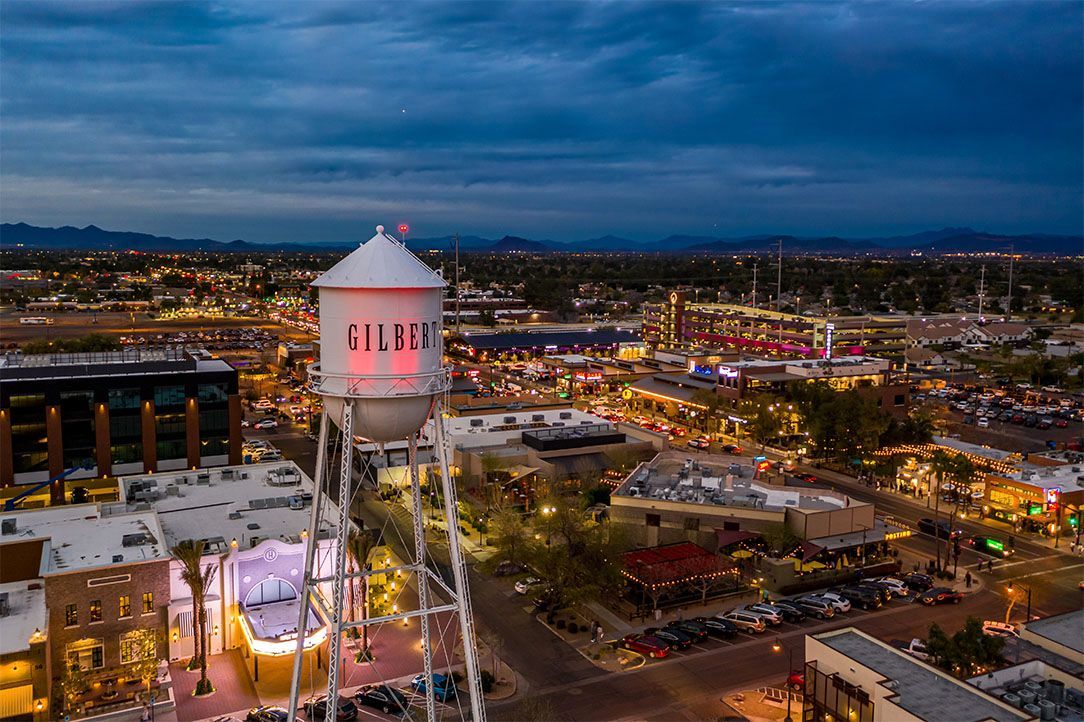
The Heritage District is the most active short-term rental zone in Gilbert, and one of the most active in the entire Phoenix metro. Properties within walkable distance of the district's restaurant and entertainment corridor — particularly in the 85233 ZIP — regularly generate $3,500–$5,000 per month in gross STR revenue during peak season.
STR underwriting for DSCR is different from long-term rental underwriting. Most lenders use a market rent analysis (Form 1007) rather than actual STR income, which typically values the property at long-term rental rates — not the premium STR rates achievable. That means a Heritage District property that clears $4,000/month on Airbnb might only underwrite at $2,400–$2,600 for DSCR purposes.
Deal example — Heritage District adjacent (STR):
The DSCR on long-term rental equivalent doesn't qualify at standard terms. But this is exactly where below-1.0 DSCR programs and no-ratio DSCR programs are designed to be used. The investment thesis is STR revenue that far exceeds LTR market rent — the lender's conservative Form 1007 analysis is just a documentation floor, not an accurate representation of what the property earns. We've closed a deal with this profile in Gilbert. It requires the right lender and the right program, but it closes.
Western Gilbert — standard long-term rental math
The western edge of Gilbert, particularly the 85233 and 85234 ZIP codes away from the Heritage District, is where conventional long-term rental DSCR math plays out most cleanly. Home prices here are more moderate — $460,000–$520,000 for three-bedroom homes — and long-term rental rates are $2,200–$2,400.
Deal example — West Gilbert, long-term rental:
Still below 1.0. This is the honest reality of much of Gilbert at current price levels and rates — the rent-to-price ratio doesn't support standard DSCR qualification on a 25% down purchase without either a lower acquisition price or a higher rent than market. Gilbert works as a DSCR market for investors who are either using larger down payments (30%+), accepting below-1.0 programs, or buying properties where condition or STR potential supports above-market rent.
Power Ranch and Morrison Ranch — the premium long-term play
Properties in Power Ranch and Morrison Ranch — Gilbert's most desirable family neighborhoods — command consistently higher rents than the rest of the city. Three-bedroom homes in Morrison Ranch lease in the $2,500–$2,800 range due to the school district premium, neighborhood quality, and tenant profile.
At $2,700/month rent on a $500,000 purchase with 25% down, the DSCR comes in at approximately 0.94. Still technically below 1.0, but close enough that a 30% down payment pushes the monthly PITIA down enough to clear the threshold. This is also the profile where a well-located property might appraise at $2,800 in the Form 1007, which changes the math meaningfully.
The deals we've actually closed in this market
These are a couple of examples from our book — we've closed many more across the East Valley and beyond.
$1,160,000 — Phoenix, AZ | Rate-and-term refinance out of hard money Investor needed to exit a hard money loan before maturity on a high-value rental. DSCR on in-place rent supported standard program terms. Closed in 22 days — speed was the primary constraint. No income documentation submitted.
$408,000 — Phoenix, AZ | Purchase, first-time investor Tight contract deadline. First-time DSCR borrower, self-employed. Property cash flow supported 1.0+ qualification. Closed in 15 days. The investor's CPA had told them they'd never qualify for a mortgage due to write-offs. DSCR doesn't care about write-offs.
$255,000 — Mesa, AZ |
Cash-out refinance to fund next acquisition
This is one of the most common uses of a
cash-out refinance in our book — pulling equity from an existing rental to fund the next acquisition without touching personal income documentation. Investor pulled equity from an existing Mesa rental to fund the down payment on the next deal. No income documentation required. Proceeds deployed within 30 days of the refinance funding into a new acquisition.
What this means for your deal
The honest summary of the East Valley DSCR market in May 2026: most of it doesn't produce 1.25+ DSCR at standard purchase leverage. Some of it barely clears 1.0. A meaningful portion of otherwise strong investment properties — particularly in Gilbert — underwrite below 1.0 on long-term rental market analysis.
That doesn't mean DSCR financing isn't available. It means the program structure matters. The investors who are closing deals in this market right now are working with brokers who know which lenders approve below-1.0 DSCR, which programs use actual STR revenue rather than Form 1007 market rent, which lenders allow no-ratio DSCR for strong-profile borrowers, and how to structure down payment and prepayment terms to optimize rate.
That's what we do. Give us the property address and the expected rent — or your last 90 days of STR data if it's a short-term rental — and we'll tell you exactly which program fits, what rate you'd pay, and whether the deal closes. No fluff, no runaround.
We ran the same deal-level analysis for Tempe, including the per-bedroom math near ASU
→ Contact us for a free DSCR analysis → Apply directly → Call or text: 800-BONELLI (800-266-3554)
Data sources:
Zumper Gilbert rent data (May 2026),
RentEst Mesa and Gilbert single-family rent data (March 2026),
Rentometer (March–April 2026),
HomeAbroad DSCR rate index (May 2026),
Defy Mortgage rate matrix (May 2026),
Zillow rental median Gilbert (May 2026). Rate calculations assume 30-year fixed, 75% LTV, 700 FICO unless otherwise noted. Property tax and insurance estimates based on typical Arizona figures for the price tier shown. Deal math is illustrative of typical submarket economics — actual results vary with property condition, appraisal, and lender program. Not a commitment to lend. Bonelli Financial Group, Branch NMLS #2621584, licensed in AZ, CA, CO, FL, ID, NM, OH, SC, TX.
FAQ: DSCR Mortgages in 2026
Why does my CPA say I can't qualify for a mortgage when I have rental income coming in every month?
This is the most common thing we hear from self-employed investors and it's a documentation problem, not an income problem. Conventional loans qualify you on taxable income after deductions. If you've done your job as a real estate investor — depreciation, cost segregation, business write-offs — your taxable income on paper looks nothing like your actual cash position. DSCR loans ignore your tax returns entirely. The property's rent is the income. If you're buying a primary residence or a property without rental income, bank statement loans may be the better path. Your CPA's concern is valid for conventional financing and irrelevant for DSCR.
The deal math you showed above has a DSCR below 1.0. Does that mean I can't get financing?
Not necessarily. Below-1.0 DSCR programs exist at legitimate lenders — typically requiring a larger down payment (30% or more), a stronger credit profile, or both. No-ratio DSCR programs also exist for borrowers with a strong overall profile where the lender evaluates the deal on asset strength and reserves rather than the cash flow ratio alone. We work with lenders across the full spectrum. A 0.80 DSCR on a well-located Gilbert property with a strong borrower profile is a different conversation than a 0.80 DSCR on a marginal deal with a 640 credit score. Bring us the deal and we'll tell you honestly what's available.
You mentioned the Form 1007 market rent analysis. What is that and why does it matter for my deal?
The Form 1007 is a single-family comparable rent schedule completed by the appraiser as part of the DSCR underwriting process. The appraiser surveys comparable rental properties in the area and establishes a market rent opinion — and that number, not your lease or your Airbnb revenue, is what most lenders use to calculate your DSCR. If your property is currently rented below market, the Form 1007 can actually help you by establishing a higher qualifying rent. If you're projecting strong Airbnb revenue on a vacant property, the Form 1007 will likely come in lower than your pro forma. Understanding this before you submit saves a lot of surprises at underwriting.
How much does a 30-basis-point difference in rate actually matter on a $400,000 DSCR loan?
More than most investors account for — and you can run your own numbers using our DSCR calculator before we talk. On a $320,000 loan amount (80% of $400K) at 6.75% vs 7.05%, the monthly payment difference is approximately $65. Over a 5-year hold that's $3,900 — real money, but not a deal-breaker on its own. Where rate shopping matters more is at the DSCR threshold. A 0.25% rate reduction on a borderline 0.98 DSCR deal can move it above 1.0 and change the entire program availability. That's why we shop multiple wholesale lenders on every file rather than routing everything to one partner — the rate difference sometimes changes whether the deal closes at all.
What's the difference between a no-ratio DSCR loan and a standard DSCR loan?
Both are explained in detail on our DSCR loans page — here's the practical difference: A standard DSCR loan qualifies based on the ratio of the property's rental income to its debt service — the lender needs that ratio to meet a minimum threshold, typically 1.0. A no-ratio DSCR loan removes the income-to-debt calculation entirely. The lender evaluates the deal based on credit, down payment, reserves, and asset profile — without requiring the rental income to cover the payment. No-ratio programs typically require stronger credit (700+), larger down payments (25–30%+), and meaningful liquid reserves. They're particularly useful for value-add properties being repositioned, short-term rentals with volatile income, or high-value properties where the acquisition thesis is appreciation rather than cash flow.
Can I use a DSCR loan to buy a property that's currently vacant?
Yes. For vacant properties, lenders use the Form 1007 market rent analysis to establish a projected rent rather than requiring an existing lease. The appraiser surveys comparable rentals and provides a market rent opinion, which becomes the income figure for your DSCR calculation. This is standard practice and is not treated as a higher-risk scenario by most DSCR lenders — it's specifically how the product is designed to work for acquisitions.
I already have eight financed properties. Will that disqualify me from a DSCR loan?
No. DSCR loans have no financed-property cap. Each loan is evaluated on the individual property's cash flow, independent of how many other properties you hold. This is one of the fundamental differences from conventional financing, which caps most borrowers at 10 financed properties and becomes increasingly restrictive past four. The investors who use DSCR most heavily are typically those who've already maxed out conventional capacity and are scaling beyond it.
What reserves do I need and do they have to be liquid?
Most DSCR programs require 6 months of PITIA in verified liquid reserves at closing — meaning funds that can be documented in bank or brokerage account statements. Retirement accounts (IRA, 401k) typically count at 60–70% of face value depending on the lender. Equity in other properties generally does not count as liquid reserves unless you're doing a concurrent cash-out refinance. Stronger files at lenders like Visio or Kiavi can sometimes qualify at 3 months. Weaker files or specialty programs may require 9–12 months. The reserve requirement is verified at closing and is not an ongoing audit — the lender doesn't check back after funding.
Is the interest on a DSCR loan tax deductible?
We're mortgage brokers, not CPAs, so confirm this with your tax advisor — but generally yes, mortgage interest on investment properties is deductible as a business expense. More importantly, DSCR loan properties held in LLCs or other entities are typically treated as business assets, making the full range of real estate investor deductions — depreciation, repairs, property management, insurance — available against the rental income. This is exactly why working with a CPA who specializes in real estate investors matters. The tax structure of your portfolio is as important as the financing structure.
We're under contract with a 21-day close. Is that realistic for a DSCR loan?
Tight but achievable depending on the appraisal turnaround in your specific submarket. Our side of the process — application, underwriting, approval — can move in under two weeks on a clean file. The variable we can't fully control is the appraisal, which in the Phoenix metro is currently running 7–12 business days for standard single-family residential. If you're under contract with a tight timeline, tell us on day one. We'll order the appraisal immediately and flag the file for priority processing. We've closed in 7 days on a clean deal where everything aligned. Twenty-one days is a real target, not a fantasy — but it requires both sides moving without delays.
Why use a broker like Bonelli instead of going directly to a DSCR lender?
Because the DSCR wholesale market has 40+ active lenders right now and their programs, rate matrices, DSCR floors, and property type eligibility vary significantly. A lender who prices aggressively on a 1.25+ DSCR single-family in Mesa may be completely uncompetitive on a 0.85 DSCR condo in Gilbert. A lender who's great for first-time investors may have overlays that knock out an investor with 12 existing properties. We know which wholesale partners price best for which deal profiles, which ones move fastest, and which ones have the most flexible DSCR floors. Going direct means you get one lender's program. Working with us means we match your specific deal to the right program across our entire lending network — and we've already closed deals at the price points and deal types we're talking about on this page.
Why Choose Bonelli Financial Group?
We are not a faceless national call center. We are a local business located at 136 W Main St #101, Mesa, AZ 85201. We live here, we work here, and we know exactly how to get your offer accepted in the East Valley.
Contact Us Today:
- Office: 136 W Main St #101, Mesa, AZ 85201
- Phone: (800) 266-3554
- Apply Online: Get Your DSCR Pre-Approval Now

About the Author: Travis Erickson
Travis Erickson is a Mesa-based mortgage broker with over 10 years in the lending industry and a specialty in DSCR, bank statement, and non-QM investment property loans. He started his career as a loan officer at Desert Financial Credit Union, built his way up to Vice President at AmeriSave Mortgage, and joined Bonelli Financial Group in 2024 to build a faster, more transparent mortgage experience for borrowers that traditional lenders often overlook.
His expertise in non-conforming and investor financing has been recognized nationally — including a citation in Bankrate's Non-Conforming Loans Guide, one of the most widely read mortgage resources in the country.
Travis has helped investors across Arizona, Texas, Florida, and six other states close DSCR deals that conventional lenders couldn't structure — often in under 30 days. He lives and works in Mesa, knows the East Valley market firsthand, and believes the best loan is the one that actually closes.
Learn more about Travis and the full Bonelli team on our Meet the Team page
NMLS # 1193479 | View Our Google Reviews | Connect on LinkedIn

When Is Expensive Money Actually Cheap? When Bridge Financing Makes Sense for a Real Estate Investor